
Medical acupuncture
Acupuncture for shoulder pain: does it help?
If your shoulder has hurt for weeks or months, you may be wondering whether acupuncture is worth trying. Here’s what the research says, and what it doesn’t.
Quick answer
It depends on what’s causing the pain, and the research is thin. A few trials found people did better with acupuncture than with pretend needles, but most were small or flawed. No UK guideline recommends it for shoulder problems. If the pain is really coming from your neck, acupuncture can give some people short-term relief of neck pain.
What’s causing your shoulder pain?
Shoulder pain isn’t one problem. The cause matters, because it changes what’s likely to help. The common ones are:
- The rotator cuff. These are the tendons that hold the shoulder in place. Pain is usually on the outside of the upper arm and worse when you lift your arm. This is the most common cause.
- Frozen shoulder. The joint becomes painful, then stiff. It’s more common in people with diabetes.
- Arthritis of the shoulder joint. This is more common over 60.
- Muscle pain across the top of the shoulder and around the shoulder blade. This often comes from the neck.
Scans can mislead. Rotator cuff changes become very common with age. One large review found them in about 1 in 10 shoulders at 20 or under, rising to about 6 in 10 over 80. The rise was similar in people with and without pain. So a scan finding isn’t always the cause.
Most shoulder pain settles with time. Rotator cuff pain often improves within about three months. Frozen shoulder takes longer, often a year or more. One study followed people for about four years. About 6 in 10 had a normal or near-normal shoulder by then, and about 1 in 20 still had severe problems.
What the research shows
Every treatment gets tested against a fake. Acupuncture is tested against pretend needles. Pretend needles often help quite a lot on their own, so beating them is a high bar.
What is sham acupuncture?
It’s pretend acupuncture used in trials. The needles go in only a little way, or in the “wrong” places, or retract into the handle without piercing the skin. It lets researchers see whether real needling does more than the experience of being treated.
The best summary pooled four trials that compared real acupuncture with sham for shoulder pain. Real acupuncture did a bit better: roughly 1 to 1.5 points on a 0 to 10 pain scale. But the authors noticed the shoulder result was much bigger than for other kinds of pain. That can be a sign that small trials are overstating it.
The largest single trial was in Germany, with 424 people who’d had shoulder pain for at least six weeks. They had 15 sessions over six weeks. Three months later, about 65 in 100 had their pain at least halved. That compared with 24 in 100 after sham, and 37 in 100 after usual care (painkillers and physiotherapy). It sounds like a big difference. But the sham needles were put in the shins, not near the shoulder. So people may have guessed which group they were in. And about a quarter didn’t complete the trial as planned.
An older Cochrane review, from 2005, found people could move their shoulder a little better after four weeks. Their pain wasn’t clearly lower than with placebo, and the difference had mostly gone by four months. It hasn’t been updated since.
For muscle pain around the shoulder, needling tight bands of muscle (sometimes called dry needling) lowered pain by about half a point out of 10, for a short time. For frozen shoulder, there are only a few small trials, and the evidence is very weak.
So the research is small and flawed. That doesn’t show acupuncture doesn’t work. It means we don’t really know.
What else helps, and what the guidelines say
Advice and exercise come first in every UK guideline, usually with a physiotherapist.
A steroid injection can ease the pain for a while. In rotator cuff pain, a large UK trial found a small benefit at eight weeks that had gone by six months. In early frozen shoulder, it has the best short-term evidence of any treatment. Pain was about one point lower out of 10 than with placebo, sometimes for up to six months. Two large UK trials found that keyhole surgery added little over simpler treatments for most people (CSAW and UK FROST).
One practical tip I give: when you lift or reach, keep your elbow close to your body and turn your palm up. Some people find this eases the catch. It’s a tip, not something that’s been tested in trials.
No UK guideline recommends acupuncture for shoulder problems:
- NICE’s guidance for GPs notes that NHS physiotherapists sometimes use acupuncture as part of physio for frozen shoulder.
- The UK shoulder surgeons’ guidance (BESS) says there isn’t enough evidence to recommend it for rotator cuff pain.
- For arthritis, NICE says not to offer acupuncture, and that includes the shoulder.
- NICE does suggest considering acupuncture for some long-term pain with no clear cause. Most shoulder pain has a cause, so that usually doesn’t apply.
- In Scotland, the national guidance on long-term pain doesn’t yet cover acupuncture. A second part is due.
When the pain is coming from your neck
Pain across the top of the shoulder and around the shoulder blade often starts in the neck. Clues are that it changes when you turn or tilt your head, and sometimes comes with tingling down the arm. Pain from the shoulder joint itself is usually felt at the front or outside of the upper arm. It’s worse when you lift your arm or reach behind you.
If your pain is coming from your neck, acupuncture can give some people short-term relief of neck pain. That’s one reason I examine your neck as well as your shoulder.
What a session involves
Your first visit starts with questions and an examination of your shoulder and neck. That way we both understand where the pain is coming from. If anything needs your GP, I’ll tell you.
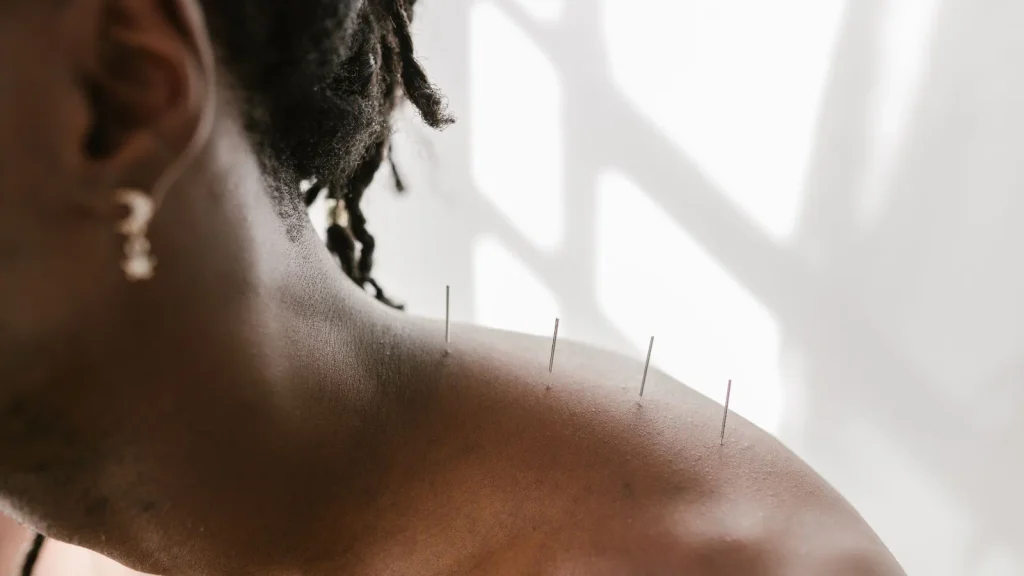
I usually use about 10 to 14 needles. Five or six go around the shoulder joint and shoulder blade. The rest go in the lower legs and feet, forearms and hands, and around the head and neck. They stay in for 20 to 30 minutes.
You’ll usually feel a very mild sensation as each needle goes in. Sometimes it’s a little sharp or achy for a moment. Once they’re all in, most people feel very little. Sometimes I connect a few needles to a small electrical device (electroacupuncture). That feels like a gentle buzz or tapping.
Around the shoulder blade, the lung isn’t far below. A collapsed lung (pneumothorax) from acupuncture is very rare. In a large German safety study of about 230,000 patients, two had one. I check where your shoulder blade is and angle the needles away from the chest. Minor side effects are more common. About 6 in 100 people get a small bruise, and a few feel sore or faint for a short time. If you get breathless or have chest pain after treatment, get help straight away.
I treat adults and teenagers.
How many sessions?
If you’d like to try it, I usually suggest three to five sessions before deciding whether it’s worth carrying on. A course is a real cost, so the prices are on my medical acupuncture page.
My view
Most of the people I see with shoulder pain have already tried physio, painkillers or an injection. Some are still in pain months later. The research on acupuncture for the shoulder is thin, so I can’t promise it will help. There’s no way to know in advance. What I can do is examine your shoulder and neck, and tell you plainly what I think is going on.
When to see your GP
Acupuncture doesn’t replace a diagnosis. The NHS advises asking for an urgent GP appointment or calling NHS 111 if:
- You have sudden or very bad shoulder pain, or you cannot move your arm.
- Your arm or shoulder has changed shape, is badly swollen, or is hot or cold to touch.
- You have pins and needles that do not go away, or there’s no feeling in your arm or shoulder.
- The pain started after an injury or accident, like a fall.
- You develop severe pain in both shoulders.
- You feel feverish or unwell.
Call 999 if you have chest pain that spreads to your arms, neck or jaw: it can be a heart attack.
Summing up
The research on acupuncture for shoulder pain is small and mostly old, and no UK guideline recommends it. Most shoulder pain gets better with time, advice and exercise. But if you’ve done the sensible things and your shoulder still hurts, it’s reasonable to want to try something else. Come and see me. I’ll examine your shoulder and neck, tell you plainly what I think is going on, and if acupuncture makes sense for you, we can start.
If you’d like to see how the evidence compares for another condition, read Acupuncture for back pain: does it help?. You can read more about treatment and prices on my medical acupuncture page.
Sources
Guidance
- NICE Clinical Knowledge Summaries: Shoulder pain (last revised November 2022).
- NICE guideline NG226, Osteoarthritis in over 16s (2022).
- NICE guideline NG193, Chronic pain in over 16s (2021).
- BESS patient care pathway: subacromial shoulder pain (2025).
- SIGN 173, Management of chronic pain (Scotland; part 1, December 2025).
- NHS: Shoulder pain and NHS inform: Heart attack.
Acupuncture research
- Cochrane review: Acupuncture for shoulder pain (Green and others, 2005). 9 trials.
- Acupuncture for chronic pain: update of an individual patient data meta-analysis (Vickers and others, Journal of Pain, 2018). Includes 4 shoulder trials.
- German acupuncture trial for chronic shoulder pain (Molsberger and others, Pain, 2010). 424 people.
- Dry needling for shoulder pain: systematic review (Navarro-Santana and others, Physical Therapy, 2021).
- Safety of acupuncture: 229,230 patients (Witt and others, 2009).
Shoulder pain and other treatments
- Prevalence of rotator cuff changes with age (Teunis and others, 2014).
- Long-term outcome of frozen shoulder (Hand and others, 2008).
- UK trial of exercise and steroid injection for rotator cuff pain (Hopewell and others, Lancet, 2021).
- Comparison of treatments for frozen shoulder (Challoumas and others, JAMA Network Open, 2020).
- CSAW: surgery for subacromial shoulder pain (Beard and others, Lancet, 2018).
- UK FROST: treatments for frozen shoulder (Rangan and others, Lancet, 2020).
Common reasons people come
Good evidence Promising Mixed evidence Little evidence yet
Try medical acupuncture
Start with one session and see how you get on. At Private Medical Rooms, 679 Clarkston Road.