
Medical acupuncture
Acupuncture for back pain: does it help?
I’m a doctor who uses acupuncture for back pain, and the honest answer is more mixed than most clinic websites suggest. This article covers what the research shows, why expert bodies disagree, and what a session involves.
Quick answer
For long-term low back pain, acupuncture can give some people short-term relief. In trials it does a little better than usual care alone, and only slightly better than sham (pretend) needling, which is why expert bodies disagree about it. It works alongside staying active, not instead of it.
What causes back pain
Most back pain doesn’t come from one thing that shows on a scan. Muscles, joints and discs can all be involved, often more than one at once.
Where the pain sits gives a clue:
- Across the middle. This often comes from a disc or the tissues around it.
- On both sides. This can be tension in the long muscles beside the spine, and stress can feed it.
- On one side. This usually comes from a muscle, one of the small joints of the spine, or both.
- Down the leg. Sciatica is an irritated nerve, and it’s usually felt as a narrow line of pain. A tight buttock muscle can cause a broader ache in the hip and thigh that gets mistaken for it.
How long you’ve had it matters too. Most new back pain improves a lot within six weeks, whatever you do. Pain that lasts more than three months is called long-term (chronic), and that’s where acupuncture has been studied most.
What the research shows
Acupuncture for back pain has been tested in dozens of trials, and researchers have pooled their results. The trials make two different comparisons, and the answers differ.
Compared with usual care
When acupuncture is added to usual care, people do better than with usual care alone. The largest pooled analysis, covering 39 trials and about 21,000 patients with long-term pain, found a moderate benefit. It also found that most of the benefit was still there a year later.
The newest trial fits that picture. In 2025, a trial in the United States followed 800 people over 65 with long-term low back pain. About 4 in 10 of those who had acupuncture improved by a meaningful amount, against about 3 in 10 who had usual care alone. That’s a real difference, and a small one.
Compared with sham needling
Sham acupuncture uses shallow needles, or needles in the “wrong” places. Here the gap narrows. Across trials, real acupuncture does a little better than sham, but only a little. A 2020 Cochrane review pooled seven trials and found a difference of just under 1 point on a 0 to 10 pain scale. The reviewers judged that too small to matter.
The largest single trial, in Germany, shows the pattern. About 48 in 100 people improved with real acupuncture, 44 in 100 with sham and 27 in 100 with standard care.
There are two ways to read this. Sceptics say that if sham needling works nearly as well, most of the benefit must come from the experience of being treated, not the needles. The British Medical Acupuncture Society, which trained me, argues that sham needling still stimulates skin and nerves, so it isn’t a true placebo. On that reading, the trials show both forms of needling work, not that neither does. Nobody disputes the results. The argument is about what they mean.
Why the guidelines disagree
- NICE, which writes guidance for England, says: “Do not offer acupuncture for managing low back pain with or without sciatica.” It recommended acupuncture in 2009 and changed its advice in 2016, mainly because of the sham results.
- The World Health Organization said in 2023 that acupuncture may be offered for long-term low back pain as part of wider care. It rated the evidence as low certainty and the benefit as short-term.
- Scotland has no current recommendation. The previous Scottish guideline said acupuncture should be considered for short-term relief of long-term low back pain. It was withdrawn in December 2025. The section of the new guideline that covers acupuncture is due this autumn, and I’ll update this article when it’s published.
They all agree on one thing: staying active and exercise come first.
What a session involves
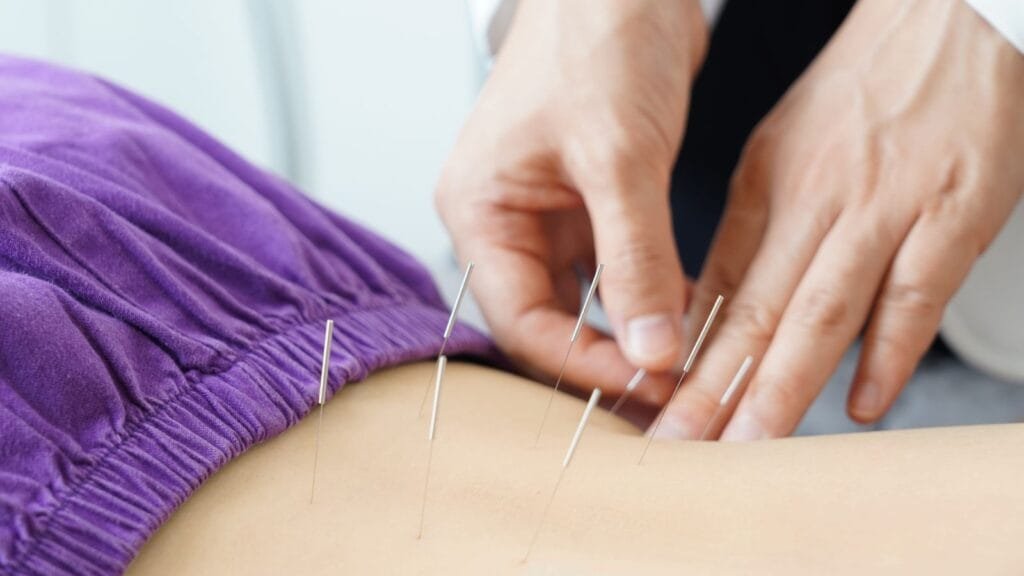
Most practitioners place fine needles in the low back and buttocks, sometimes with a few in the legs or hands. I usually use about 10 to 16. The needles stay in for 20 to 30 minutes.
I start with a medical and pain history. Then I examine how you move, where you’re tender and how the nerves in your legs are working. That gives me a sense of where the pain is coming from, and whether you need to see someone else first.
I also look for trigger points. These are tight, tender spots in a muscle that can send pain elsewhere when pressed. Sometimes they seem to be the main source of the pain. Often they’re a reaction to a problem deeper in the back, such as a joint or disc. If I find them, I needle directly into the tight band of muscle, which is sometimes called trigger point acupuncture or dry needling.
After that I place needles at key points in the back, with you sitting or lying. I sometimes add points further away, and sometimes pass a small electrical current between two needles (electroacupuncture), which feels like a gentle tapping.
Most people feel a dull, deep ache around the needle, with the odd short, sharper moment as it goes in. Tell me if anything is more than that and I’ll move it.
How many sessions
The trials that found a benefit used 8 to 15 sessions, usually once or twice a week. In practice, some people notice a change after the first session. More often any benefit builds over a course of weekly sessions, typically five to eight. Some people get no benefit, and if that’s you I’ll say so early rather than keep going.
Side effects and safety
In a German study of about 230,000 patients, about 1 in 12 reported a side effect. Most were a small bleed or bruise. Serious problems were rare: two people had a collapsed lung.
Some people feel sleepy afterwards, and a few get a short flare of their usual pain.
Tell me before treatment if you:
- take blood thinners or have a bleeding disorder
- have had surgery on your spine, or have metal implants there
- have a pacemaker or an implanted stimulator
- are pregnant
My view
My view is that acupuncture is worth trying for long-term low back pain if you’ve done the basics, such as staying active, exercise and physiotherapy, and still have pain. Many of the people I see are in exactly that position. They’ve done what they were told and they’re frustrated. Some of them appear to do very well. I know the trials show a modest effect, and there’s no way to know in advance whether you’ll be one of the people who benefits. I still think it’s worth a try. It also suits people who’d prefer a treatment without medication. I’d give it five to eight sessions before judging it.
When to see your GP
Acupuncture doesn’t replace a diagnosis. Call 999 or go to A&E if back pain comes with:
- numbness around your genitals or bottom
- new difficulty passing urine, or loss of bladder or bowel control
- weakness or numbness in both legs
See your GP if the pain is worse when you lie down, follows a fall, comes with a fever or unexplained weight loss, or hasn’t improved after six weeks. NHS inform has more on back problems.
Summing up
Acupuncture can give some people short-term relief of long-term low back pain. The benefit over usual care is small, the benefit over sham needling is smaller, and good experts disagree about whether that’s enough. If you try it, keep moving, and judge it after five to eight sessions.
You can read more about treatment on my medical acupuncture page.
Sources
- NICE guideline on low back pain and sciatica (NG59)
- World Health Organization guideline on chronic low back pain (2023)
- SIGN 173: Management of chronic pain
- Cochrane review: acupuncture for chronic low back pain (2020)
- Acupuncture for chronic pain: pooled analysis of 39 trials (2018)
- BackInAction trial of acupuncture in older adults (2025)
- German Acupuncture Trials for chronic low back pain (2007)
- Safety of acupuncture in 229,230 patients (2009)
Book medical acupuncture
Monday to Friday, 9am to 7pm, at Private Medical Rooms, 679 Clarkston Road.